
Your shopping cart is empty!

Choosing the best organic milk formula is one of the most significant steps toward ensuring your infant's long-term health. An organic milk formula provides a clean nutritional foundation by excluding synthetic pesticides, growth hormones, and GMOs. Unlike conventional options, these formulas rely on high-quality ingredients sourced from certified organic farms. Parents often prefer organic milk formula because it uses natural lactose rather than corn syrup or artificial sweeteners. By prioritizing purity, you give your baby a healthy start that supports their developing immune and digestive systems.
Free shipping starts from 4 boxes for milk formula.

-280x327.jpg)


-280x327.jpeg)


-280x327.png)


From birth
Contains DHA & AA
Contains Lutein
EU standards
Made in Netherlands
Contains DHA & AA
Contains Lutein
EU standards
Made in Netherlands
$64.99
From 12 months
Contains DHA & AA
Contains Lutein
EU standards
Made in Netherlands
Contains DHA & AA
Contains Lutein
EU standards
Made in Netherlands
$64.99
From 6 months
Contains DHA & AA
Contains Lutein
EU standards
Made in Netherlands
Contains DHA & AA
Contains Lutein
EU standards
Made in Netherlands
$64.99
From 12-36 months
Plant-based Omega-3 DHA
No Palm Oil
EU standards
Made in UK
Plant-based Omega-3 DHA
No Palm Oil
EU standards
Made in UK
$66.99
From 24 month
Contains Omega 3 & 6
Contains Prebiotic & Probiotic
EU organic certified
Made in Netherlands
Contains Omega 3 & 6
Contains Prebiotic & Probiotic
EU organic certified
Made in Netherlands
$47.99
From birth
Contains Omega 3
Contains DHA
EU organic certified
Made in Netherlands
Contains Omega 3
Contains DHA
EU organic certified
Made in Netherlands
$39.99
From birth
Contains Omega 3 & 6
Contains Prebiotic
EU organic certified
Made in Netherlands
Contains Omega 3 & 6
Contains Prebiotic
EU organic certified
Made in Netherlands
$47.99
From 6 months
Contains Omega 3
Contains DHA
EU organic certified
Made in Netherlands
Contains Omega 3
Contains DHA
EU organic certified
Made in Netherlands
$39.99
From 6 months
Contains Omega 3
Contains Prebiotic & Probiotic
EU organic certified
Made in Netherlands
Contains Omega 3
Contains Prebiotic & Probiotic
EU organic certified
Made in Netherlands
$47.99
From 12 month
Contains Omega 3
Contains Prebiotic
EU organic certified
Made in Netherlands
Contains Omega 3
Contains Prebiotic
EU organic certified
Made in Netherlands
$47.99
From birth
Contains ARA (Omega-6)
Made from gentle A2 goat milk
EU standards
Made in Germany
Contains ARA (Omega-6)
Made from gentle A2 goat milk
EU standards
Made in Germany
$35.99
From birth
Contains Omega 3 & 6
Contains Prebiotic
EU organic certified
Made in Germany
Contains Omega 3 & 6
Contains Prebiotic
EU organic certified
Made in Germany
$37.99
From 10 months
Contains Vitamin D & Calcium
Contains Prebiotic & Probiotic
EU organic certified
Made in Germany
Contains Vitamin D & Calcium
Contains Prebiotic & Probiotic
EU organic certified
Made in Germany
$37.99
From birth
Contains Omega 3 & 6
Contains prebiotic & Probiotic
EU organic certified
Made in Germany
Contains Omega 3 & 6
Contains prebiotic & Probiotic
EU organic certified
Made in Germany
$39.99
From 6 months
Contains Omega 3
Contains Prebiotic & Probiotic
EU organic certified
Made in Germany
Contains Omega 3
Contains Prebiotic & Probiotic
EU organic certified
Made in Germany
$37.99
From 12 months
Contains Omega 3
Contains Prebiotic & Probiotic
EU organic certified
Made in Germany
Contains Omega 3
Contains Prebiotic & Probiotic
EU organic certified
Made in Germany
$37.99
From birth
Contains Omega 3 & 6
Contains Prebiotic
EU organic certified
Made in Germany
Contains Omega 3 & 6
Contains Prebiotic
EU organic certified
Made in Germany
$45.99
From 6 months
Contains Iron and Iodine
Contains Prebiotic
EU organic certified
Made in Germany
Contains Iron and Iodine
Contains Prebiotic
EU organic certified
Made in Germany
$45.99
From 6-12 months
Plant-based Omega-3 DHA
No Palm Oil
EU standards
Made in UK
Plant-based Omega-3 DHA
No Palm Oil
EU standards
Made in UK
$64.99
Out of stock
From 0-6 months
Plant-based Omega-3 DHA
No Palm Oil
EU standards
Made in UK
Plant-based Omega-3 DHA
No Palm Oil
EU standards
Made in UK
$64.99
Out of stock
From 6 months
Contains ARA (Omega-6)
Made from gentle A2 goat milk
EU standards
Made in Germany
Contains ARA (Omega-6)
Made from gentle A2 goat milk
EU standards
Made in Germany
$35.99
Out of stock
From 12 months
Contains Iron
Contains Vitamin A, C, D
EU organic certified
Made in Germany
Contains Iron
Contains Vitamin A, C, D
EU organic certified
Made in Germany
$39.99
Out of stock
European Baby Formula & Organic Baby Food
When you're choosing formula for your baby, the brand name is only part of the picture. You also want to know what's actually inside the can. That's why many parents in the US take a closer look at European baby formula. They're interested in organic ingredients, where the milk comes from, and the standards used to make baby food. For moms, it's another way to find an alternative to familiar American brands and choose a product with ingredients they understand.
Our store carries authentic European formula, organic milk baby, and baby food for different ages. We source our products from certified European distributors, so you can feel more confident about where they come from. Compare ingredients, explore different brands, and choose what suits your baby's age and nutritional needs.
Our Japanese & European Baby Goods collection also includes everyday essentials for babies and toddlers, so you can find more of what your little one needs in one place.
Why US Parents Choose European Organic Baby Formula Over Conventional Options
When you're picking out formula, the promises on the front of the can only tell you so much. What kind of milk is used? What else goes into it? Those are some of the questions that lead parents in the US to explore European organic baby formula.
The European Union has detailed rules for infant formula ingredients. For example, sucrose is permitted only in certain formulations, while the use of glucose syrup is restricted. Many brands also offer products without added flavorings. Still, it's worth reading the ingredients on the actual can rather than making a decision based only on where it was made.
Many European organic formulas start with cow's milk. Some brands use organic milk from cows raised on pasture. Lactose, the sugar naturally found in milk, is often the main source of carbohydrates.
For parents comparing organic milk for baby formula, the source of the ingredients and the recipe both matter. But even a European organic formula made with lactose won't necessarily prevent gas or colic. If your baby regularly seems uncomfortable after feeding, talk to your pediatrician.
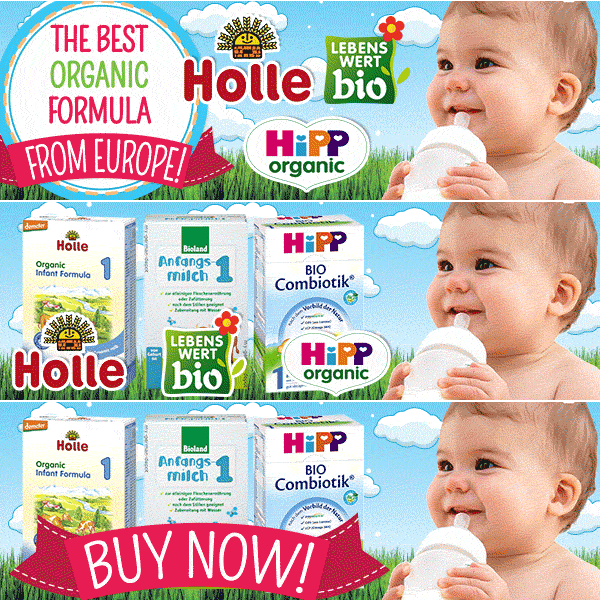
Top European Baby Formula Brands: HiPP, Holle, Kendamil & Lebenswert
European formulas don't all have the same recipe, and the familiar Organic label doesn't tell you everything. The differences become clearer when you compare four popular brands.
HiPP. The brand has several age-specific ranges, including Organic Combiotic. Some versions combine GOS prebiotics with L. fermentum cultures originally isolated from human breast milk. Both HiPP Germany and HiPP UK offer formulas for different stages of your baby's growth. Recipes may differ between markets, so it's worth checking the specific product.
Holle. This brand has a long history of working with biodynamic agriculture. Some of its cow's milk and goat's milk formulas carry Demeter certification. Look beyond the organic seal when choosing a pack. The ingredients and nutritional composition can change from one stage to another as your baby grows.
Kendamil. Its formulas are made with whole cow's milk or goat's milk. The brand doesn't use palm oil, which is something many parents specifically look for when comparing ingredients. Keep in mind that goat's milk formula isn't automatically suitable for babies with a cow's milk protein allergy.
Lebenswert Bio. Associated with Holle, this brand offers organic milk formula products made according to Bioland standards. It's worth exploring if you pay close attention to where ingredients come from and how they're produced.
Before ordering, check the age recommendation, ingredients, and preparation instructions. Even within one brand, different stages may have different recipes.
Understanding Organic Whole Milk and Stage-Based Nutrition for Babies
Those PRE, 1, 2, and 3 labels can be confusing, especially when the cans look almost identical. The numbers refer to different age ranges and formula compositions.
European brands commonly use the following stages:
- Stage PRE and Stage 1 (0-6 months) - infant formulas that can be used from birth.
- Stage 2 (6-12 months) - follow-on formulas for babies who are starting to eat solid foods alongside milk feeds.
- Stage 3 (Toddler) - formulas for older babies and toddlers. Some brands offer Stage 3 from around 10 months, while others recommend it from 12 months.
Formula made with whole organic milk deserves a closer look, too. Milk fat contains milk fat globule membranes (MFGM), which include phospholipids and proteins. Researchers are still studying how these components may contribute to brain development.
That doesn't mean every whole-milk formula is better than one made with vegetable oils. The complete nutritional composition matters. And remember, regular organic milk isn't a replacement for infant formula during your baby's first year.
Safe Transitioning to European Organic Formula
Before switching formulas, it's best to check with your pediatrician, especially if your baby has allergies or uses a specialized formula. When moving between standard formulas of the same type, you can choose a gradual transition over 4-7 days:
- Days 1-2. Replace one daytime feeding with the new formula.
- Days 3-4. If your baby is tolerating it well, use the new formula for about half of their feedings.
- Days 5-7. Gradually replace the remaining feedings until you've switched completely.
Prepare each formula according to its own instructions, using the scoop provided with that product. Watch how your baby responds. If they develop repeated vomiting, a significant rash, or blood in their stool, seek medical advice. A gradual switch doesn't guarantee there won't be any discomfort.
Along with European baby formula, we also carry Japanese baby diapers from popular brands for babies at different stages of growth.
Frequently Asked Questions
Why is European baby formula considered cleaner than US brands?
European organic formulas appeal to parents because of their organic ingredients and strict production standards. Lactose is the main carbohydrate in many recipes, while the use of certain other sugars and syrups is restricted. US formulas are also regulated.
What is the difference between Stage PRE, Stage 1, and Stage 2 formulas?
PRE and Stage 1 are suitable from birth. PRE typically uses lactose, while some Stage 1 formulas may also contain starch. Stage 2 is intended for babies from six months who are starting solid foods.
Are European formulas safe for babies with sensitive stomachs?
HiPP offers formulas with prebiotics, while Holle has goat's milk options. Every baby responds differently, though, and neither guarantees relief from colic. If your baby frequently has digestive discomfort, speak with your pediatrician.
How fast are European baby formulas shipped within the USA?
We ship orders from our US warehouse the same or next business day. Delivery times depend on your location and the carrier. You can check the estimated arrival date during checkout.